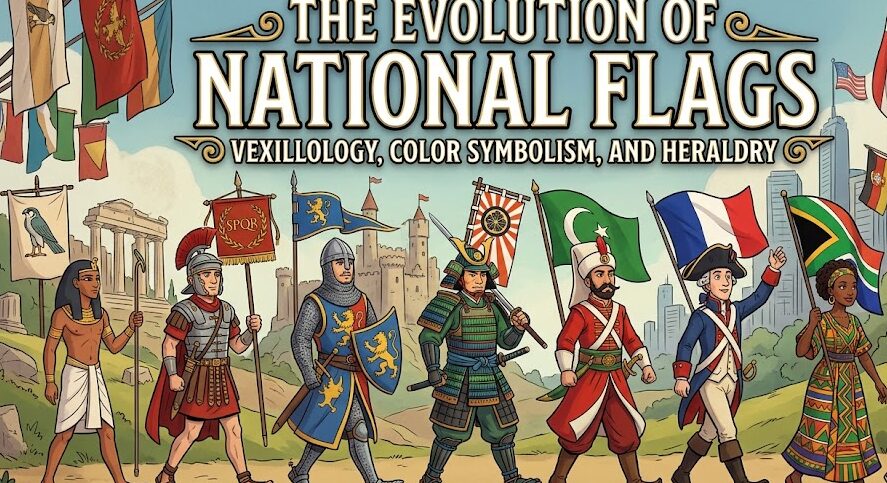
National flags are the most universally recognized emblems of human sovereignty, collective identity, and political ideology on Earth. From sovereign embassies in Geneva to maritime cargo ships plying international shipping lanes, these pieces of colored fabric encapsulate centuries of revolutionary struggles, territorial agreements, cultural narratives, and heraldic traditions. The formal scholarly discipline dedicated to the history, design, and cultural significance of flags is known as vexillology—a term coined in 1957 by American scholar Dr. Whitney Smith from the Latin vexillum, meaning a military standard or banner carried by ancient Roman cavalry.
Historical Genesis: From Battlefield Markers to Civic Sovereignty
In the ancient and medieval worlds, flags did not represent entire civilian populations or nation-states. Instead, they served functional tactical purposes on chaotic battlefields, allowing commanders to identify troop formations, signal maneuvers, and mark the personal presence of a monarch or feudal lord. These early standards, such as the Roman Aquila (Eagle) or the dragon standards of imperial China, were personal insignia rooted in aristocratic heraldry.
The transition toward true national flags began at sea. During the Age of Sail in the sixteenth and seventeenth centuries, the rapid expansion of armed merchant fleets required a reliable, visible method for identifying the nationality, legal jurisdiction, and naval authority of vessels on the high seas. Maritime ensigns gradually evolved into symbols representing sovereign nation-states, a transformation accelerated by the American and French Revolutions of the late eighteenth century, which transferred sovereignty from the monarch’s crown to the citizenry.
| Color Family / Pattern | Key Regions & Nations | Historical Origin | Primary Symbolic Meaning |
|---|---|---|---|
| Pan-Slavic Colors (White, Blue, Red) | Russia, Serbia, Slovakia, Slovenia, Czechia | 1696 Russian naval standard / 1848 Prague Slavic Congress | Slavic kinship, sovereignty, peace, and courage. |
| Pan-Arab Colors (Black, White, Green, Red) | Jordan, Egypt, Iraq, UAE, Palestine, Kuwait | 1916 Arab Revolt against Ottoman Empire | Historic caliphates: Abbasid (black), Umayyad (white), Fatimid (green), Hashemite (red). |
| Pan-African Colors (Red, Gold, Green) | Ghana, Senegal, Mali, Guinea, Cameroon | Flag of Ethiopia (historic uncolonized African state) | Bloodshed in liberation (red), mineral wealth (gold), fertile land (green). |
| Nordic Cross | Denmark, Sweden, Norway, Finland, Iceland | 1219 Dannebrog (Danish flag; world’s oldest continuous flag) | Christian heritage; horizontal cross off-centered toward the hoist. |
| Revolutionary Tricolor | France, Italy, Ireland, Mexico, Romania | 1789 French Revolution | Liberty, equality, fraternity; republican break from royal heraldry. |
Vexillological Design Families: Shared Heritage and Cultural Blocks
A rigorous examination of the world’s 195 sovereign flags reveals that the vast majority belong to distinct visual design families, reflecting shared historical revolutions, linguistic bonds, or anti-colonial liberation movements.
1. The French Tricolor and Republican Governance
When French revolutionaries stormed the Bastille in 1789, they rejected the traditional royal white flag of the Bourbon dynasty, combining the blue and red militia colors of Paris with royal white to create the iconic vertical tricolor. The simplicity of vertical stripes represented an intentional rupture from ornate aristocratic coats of arms. Over the nineteenth century, the tricolor became the international template for emerging constitutional republics across Europe and Latin America, directly inspiring the flags of Italy (green-white-red), Ireland (green-white-orange), and Mexico.
2. The Pan-African Movement and Ethiopian Inspiration
When nations across Sub-Saharan Africa achieved independence from European colonial rule in the 1950s and 1960s, they sought a visual symbol of continental liberation and anti-imperial solidarity. They looked to the Ethiopian Empire, which had successfully defeated Italian colonial invaders at the Battle of Adwa in 1896, preserving its sovereignty as the only uncolonized historic African nation. Ghana, the first Sub-Saharan nation to achieve independence in 1957, adopted Ethiopia’s green, yellow, and red color scheme (adding a black star to represent African emancipation). Dozens of African nations, including Senegal, Mali, Guinea, and Cameroon, followed suit.
3. The Pan-Arab Colors and Dynastic History
Flags across the Middle East and North Africa frequently feature four distinct colors: black, white, green, and red. Each color represents a major era or dynasty of Arab Islamic civilization. Black represents the Abbasid Caliphate and the banner of the Prophet Muhammad; white symbolizes the Umayyad Caliphate; green represents the Fatimid Caliphate and paradise; and red denotes the Hashemite dynasty and the blood of fallen martyrs. Combined during the 1916 Arab Revolt against Ottoman dominion, these colors now adorn the national banners of Jordan, Egypt, Iraq, the United Arab Emirates, and Sudan.
The Heraldic Law of Tinctures: Science of High Contrast
Flag design is deeply indebted to medieval European heraldry, particularly the fundamental Rule of Tincture. Originating around the twelfth century, this rule governs how colors can be combined to maximize visibility across vast, smoke-filled battlefields or across miles of open ocean.
In heraldry, tinctures are strictly categorized into two groups:
Metals (Light Tinctures): Argent (White or Silver) and Or (Yellow or Gold).
Colors (Dark Tinctures): Gules (Red), Azure (Blue), Sable (Black), Vert (Green), and Purpure (Purple).
The foundational rule dictates that metal must never be placed on metal, and color must never be placed on color. Contrast must be maintained by alternating a metal and a color. For example, the flag of Germany alternates black (color), red (color), and gold (metal)—violating strict heraldic tincture by placing black against red, whereas the flag of the United Kingdom separates red and blue fields with white fimbriation strips, adhering strictly to tincture rules to preserve optical clarity at extreme distances.
Frequently Asked Questions About National Flags
What is the oldest continuously used national flag in the world?
The Dannebrog, the national flag of Denmark, holds the Guinness World Record as the oldest continuously used sovereign national flag. According to historical tradition, the white-cross-on-red banner fell from the heavens during the Battle of Lyndanisse (modern Tallinn, Estonia) on June 15, 1219, and has remained Denmark’s official state standard ever since.
Why is purple almost never found on national flags?
Throughout ancient and medieval history, purple dye (Tyrian purple) was derived by crushing tens of thousands of rare spiny dye-murex sea snails harvested in Phoenicia (modern Lebanon). The extraction process was so labor-intensive that purple fabric was literally worth more than its weight in gold, reserved exclusively for Roman emperors and royal monarchs. Consequently, nations could not afford to manufacture thousands of purple banners. Today, only two sovereign flags contain purple: Dominica (featuring the purple feathers of the Sisserou parrot) and Nicaragua (featuring a tiny purple stripe within a rainbow in its central coat of arms).
What is the difference between a national flag and a civil ensign?
A national flag is the primary territorial emblem flown on land by government buildings, public institutions, and citizens. A civil ensign is a specialized maritime flag flown by privately owned commercial vessels and yachts registered in that country, often featuring distinct modifications (such as Britain’s Red Ensign or Australia’s Civil Ensign) to signify mercantile registration under international maritime law.