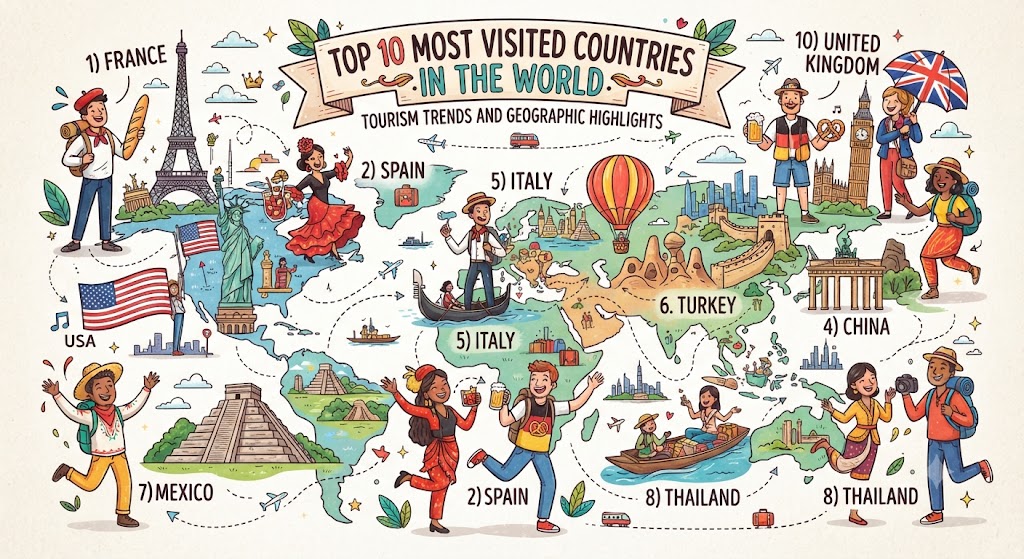
International tourism represents one of the largest and fastest-growing economic sectors on the planet, driving foreign exchange earnings, infrastructure modernization, and cultural exchange. According to data compiled by the United Nations World Tourism Organization (UNWTO), global international tourist arrivals exceed 1.4 billion travelers annually. However, international leisure travel is not evenly distributed across the globe: a select group of ten nations captures over 40% of all international arrivals. Exploring these premier destinations reveals how a nation’s physical geography, heritage preservation, transport connectivity, and culinary culture combine to create global tourism powerhouses.
The Geography of Travel: Why Certain Nations Dominate
The geographic concentration of global tourism is governed by three primary structural factors:
Geographic Centrality & Proximity: Nations situated in proximity to large, affluent population centers with open borders (such as Western Europe’s Schengen Area) benefit from frictionless overland railway and short-haul flight travel.
Diversity of Climates and Landscapes: Countries possessing both sun-drenched coastal beaches for summer recreation and alpine mountains for winter sports can sustain balanced year-round tourist inflows.
Density of Tangible Cultural Heritage: The concentration of ancient archaeological monuments, world-class art museums, architectural marvels, and designated UNESCO World Heritage sites acts as an enduring magnetic draw.
| Global Rank | Country | Annual International Arrivals | Top Geographic & Heritage Highlights | Primary Tourism Season |
|---|---|---|---|---|
| 1 | France | ~89–100 million | Paris, French Riviera (Côte d’Azur), Loire Valley châteaux, French Alps. | May to October (Year-round city tourism) |
| 2 | Spain | ~84–88 million | Costa del Sol, Balearic Islands, Barcelona, Alhambra of Granada, Madrid. | June to September (Coastal sun & beach) |
| 3 | United States | ~67–79 million | New York City, Grand Canyon, Yellowstone, Florida theme parks, California coast. | May to September (Regional variation) |
| 4 | Italy | ~57–65 million | Rome Colosseum, Venice canals, Florence Renaissance art, Amalfi Coast. | April to October |
| 5 | Turkey (Türkiye) | ~50–55 million | Istanbul historic core, Cappadocia fairy chimneys, Turquoise Coast (Antalya). | May to October |
| 6 | Mexico | ~42–45 million | Cancún & Riviera Maya, Oaxaca cultural center, Mexico City, Chichen Itza. | December to April (Dry winter season) |
| 7 | United Kingdom | ~37–40 million | London historic monuments, Scottish Highlands, Edinburgh Castle, Stonehenge. | June to August |
| 8 | Germany | ~35–39 million | Bavarian Alps, Neuschwanstein Castle, Berlin historical sites, Rhine Valley. | May to September & December (Christmas markets) |
| 9 | Greece | ~32–36 million | Acropolis of Athens, Cycladic islands (Santorini, Mykonos), Crete, Meteora. | May to October (Peak July–August) |
| 10 | Austria / Japan | ~31–33 million | Vienna palaces, Austrian Alps / Kyoto temples, Mt. Fuji, Tokyo neon metropolis. | Year-round (Cherry blossom spring & autumn foliage) |
Deep-Dive: The World’s Top Tourism Titans
1. France: The Undisputed Sovereign of Global Arrivals
Holding the number one global position for over three consecutive decades, France welcomes nearly 100 million international visitors annually. France’s geographic supremacy stems from its extraordinary diversity packed into a compact, easily traversable territory. Within a single day’s train travel on high-speed TGV rail lines, visitors can transition from the world-class museums and cafe culture of Paris to the Mediterranean yachting harbors of Nice, the sun-drenched vineyards of Bordeaux, or the snow-capped glacial peaks of Chamonix-Mont-Blanc.
Furthermore, France’s geographical location at the exact crossroads of Western Europe makes it an unavoidable transit corridor for British, German, Dutch, and Belgian vacationers driving south toward the Iberian peninsula.
2. Spain: The Coastal and Cultural Powerhouse
Spain commands second place globally, attracting over 85 million international visitors. With more than 8,000 kilometers of coastline spanning the Atlantic and Mediterranean, alongside the subtropical Canary and Balearic Islands, Spain perfected the modern European “sun-and-beach” holiday model.
Beyond its coastal resorts, Spain boasts the fourth-highest number of UNESCO World Heritage sites in the world (50 sites). The Moorish architectural masterpieces of Andalusia (the Alhambra in Granada, the Mezquita in Córdoba), the avant-garde Catalan Modernism of Antoni Gaudí in Barcelona (La Sagrada Família), and the pilgrimage routes of the Camino de Santiago across northern Spain attract millions of cultural travelers year-round.
3. The United States: Monumental Landscapes and Cultural Capital
While European destinations dominate in raw arrivals due to inter-country short-haul travel, the United States ranks number one globally in total international tourism receipts, generating over $200 billion in visitor spending annually. The US offers immense geographic scale: the vast geological chasms of the Grand Canyon, the thermal geysers of Yellowstone, the sub-tropical swamps of the Everglades, and iconic global entertainment capitals like New York City, Los Angeles, and Las Vegas.
Frequently Asked Questions About Global Tourism
What is the most visited city in the world?
Depending on annual international arrival metrics, Bangkok (Thailand), Paris (France), and London (United Kingdom) consistently compete for the title of the world’s most visited city, each welcoming between 19 and 23 million international overnight visitors annually.
Which country earns the most revenue from international tourists?
The United States consistently ranks number one in international tourism revenue (receipts) by a wide margin, generating over $210 billion annually, due to higher average lengths of stay and higher expenditures per visitor compared to short-haul European weekend travelers.
What is the least visited sovereign nation on Earth?
The remote South Pacific island nation of Tuvalu is widely recognized as the least visited sovereign country in the world, receiving fewer than 3,000 international visitors per year, primarily due to its extreme geographic isolation and limited commercial flight connectivity.