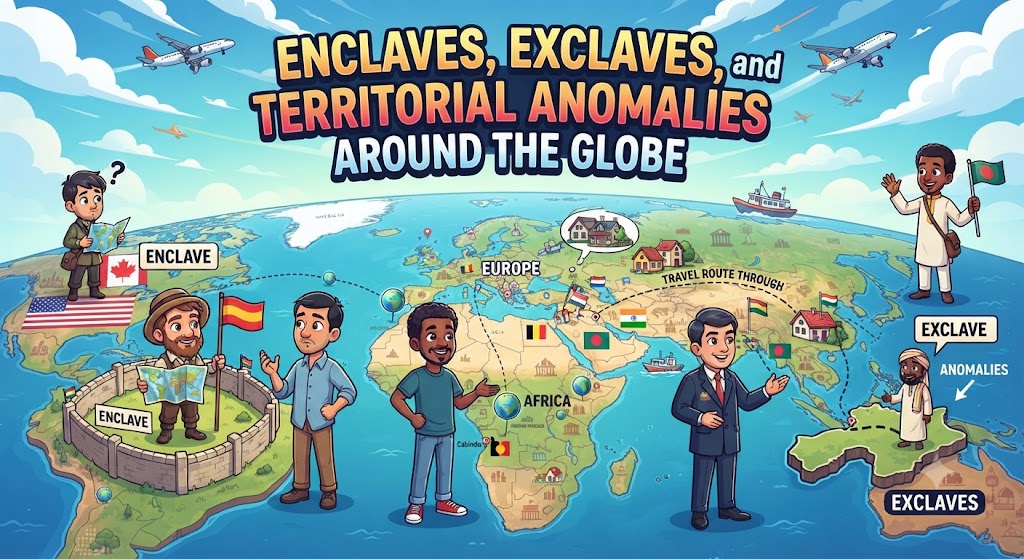
National borders are often depicted on political world maps as crisp, continuous lines neatly partitioning sovereign states. In reality, centuries of dynastic marriages, feudal real estate treaties, colonial partition blunders, and wartime armistices have left the political world map scattered with bizarre territorial anomalies. Among the most intriguing phenomena in political geography are enclaves—territories completely surrounded by the territory of a single foreign sovereign state—and exclaves—portions of a country geographically separated from its mainland by foreign territory. These spatial anomalies generate complex international dilemmas regarding customs, citizenship, transportation corridors, and sovereign security.
Terminology: The Crucial Difference Between Enclaves and Exclaves
While often used interchangeably in popular media, enclaves and exclaves are mathematically and legally distinct concepts:
Enclave: A piece of land that is completely surrounded by the territory of one other state. An enclave can be an entire sovereign country (an enclave state like Lesotho) or a detached portion of a country completely enclosed inside another nation.
Exclave: A portion of a state geographically separated from the main part by the territory of one or more foreign states. An exclave is defined from the perspective of the parent state. For example, Kaliningrad is an exclave of Russia, but it is not an enclave because it borders two different sovereign nations (Poland and Lithuania) and has an open coastline along the Baltic Sea.
| Territory | Sovereign Parent Nation | Surrounding / Separating State(s) | Type / Classification | Historical / Strategic Context |
|---|---|---|---|---|
| Lesotho | Kingdom of Lesotho (Sovereign) | South Africa exclusively | True Enclave State | Basotho mountain fortress preserved from Boer and British annexation. |
| San Marino | Republic of San Marino (Sovereign) | Italy exclusively | True Enclave State | Oldest continuous constitutional republic in the world (founded 301 CE). |
| Vatican City | Holy See (Sovereign) | Italy (City of Rome) exclusively | True Enclave State | Smallest sovereign state; established under the 1929 Lateran Treaty. |
| Kaliningrad | Russian Federation | Poland, Lithuania & Baltic Sea | Exclave (Semi-enclave) | Former East Prussia (Königsberg) ceded to USSR after World War II; vital ice-free naval port. |
| Baarle-Hertog / Baarle-Nassau | Belgium / Netherlands | Mutual counter-enclaves | Enclave complex (Enclaves within enclaves) | Medieval feudal land swaps dating back to 1198 between Duke of Brabant and Lord of Breda. |
| Point Roberts | United States (Washington State) | Canada (British Columbia) & Strait of Georgia | Practical Exclave (Pene-exclave) | Accidental byproduct of the 1846 Oregon Treaty establishing the 49th parallel border. |
The World’s Only Three Enclave Sovereign States
Across the entire international community, only three sovereign nation-states exist that are completely surrounded by the territory of a single foreign nation:
1. The Kingdom of Lesotho
Encompassing 30,355 square kilometers, Lesotho is the largest enclave state on Earth, completely encircled by the Republic of South Africa. Situated entirely above 1,400 meters in elevation within the soaring Maloti and Drakensberg mountain ranges, it is the only sovereign state in the world whose entire territory sits above 1,000 meters. Under King Moshoeshoe I in the nineteenth century, the Basotho people leveraged their impregnable alpine terrain to repel both Boer expansion and Zulu incursions, securing British protectorate status that preserved its distinct sovereignty when South Africa unified in 1910.
2. The Republic of San Marino
Perched atop Mount Titano in central Italy, San Marino spans just 61 square kilometers. Founded according to tradition in 301 CE by Saint Marinus, a Christian stonemason fleeing Roman persecution, San Marino is the oldest surviving sovereign republic and constitutional state in the world. When Giuseppe Garibaldi led the unification of Italy (Risorgimento) in the 1860s, he honored San Marino’s hospitality in sheltering Italian freedom fighters by officially guaranteeing its sovereign independence.
3. The State of the Vatican City
Covering 0.49 square kilometers inside the municipal boundaries of Rome, Vatican City is an absolute elective monarchy governed by the Bishop of Rome (the Pope). Its sovereign enclave status was formalized by the Lateran Pacts of 1929 between Pope Pius XI and Italian Prime Minister Benito Mussolini, terminating the sixty-year “Roman Question” following the annexation of the Papal States in 1870.
The Feudal Puzzle: Baarle-Hertog and Baarle-Nassau
The town of Baarle, situated straddling the border between Belgium and the Netherlands, represents the most complex territorial enclave puzzle in human history. The municipality consists of 22 separate Belgian enclaves (Baarle-Hertog) surrounded by Dutch territory. Inside those Belgian enclaves are seven Dutch counter-enclaves (pieces of the Netherlands inside pieces of Belgium that are inside the Netherlands).
This cartographic maze originated in 1198 from a series of feudal land parcel transactions between Henry I, Duke of Brabant, and Godfried II of Breda. When Belgium separated from the Netherlands in 1830, neither state could agree on a simplified border, so they codified the exact feudal parcel maps down to individual houses. Today, white crosses marked with “NL” and “B” are painted across streets, restaurants, and living rooms. The nationality of a building is legally determined by the position of its front door: if the border bisects a house, changing the front door’s location can alter a resident’s taxation, building codes, and municipal services.
Frequently Asked Questions About Territorial Anomalies
What was the India-Bangladesh enclave exchange?
Until 2015, the border district of Cooch Behar between India and Bangladesh contained 162 enclaves, including the world’s only third-order enclave (Dahala Khagrabari: a piece of India inside a piece of Bangladesh, inside a piece of India, inside Bangladesh). In July 2015, the two governments enacted a historic Land Boundary Agreement, swapping 162 enclaves and granting citizenship choices to over 50,000 residents, bringing an end to a centuries-old humanitarian and bureaucratic nightmare.
Why does Russia own the Kaliningrad exclave?
Prior to World War II, Kaliningrad was known as Königsberg, the historic capital of German East Prussia. At the 1945 Potsdam Conference following Nazi Germany’s defeat, the Allied powers transferred northern East Prussia to the Soviet Union. Following the 1991 dissolution of the USSR, Lithuania and Belarus became independent nations, leaving Kaliningrad physically detached from Russia as a heavily militarized exclave on the Baltic Sea.
What is a condominium in international law?
In political geography, a condominium is a sovereign territory over which multiple sovereign states agree to share joint dominion equally. The most famous example is Pheasant Island on the Bidassoa River between France and Spain, which alternates sovereignty every six months (governed by Spain from February to July, and by France from August to January).