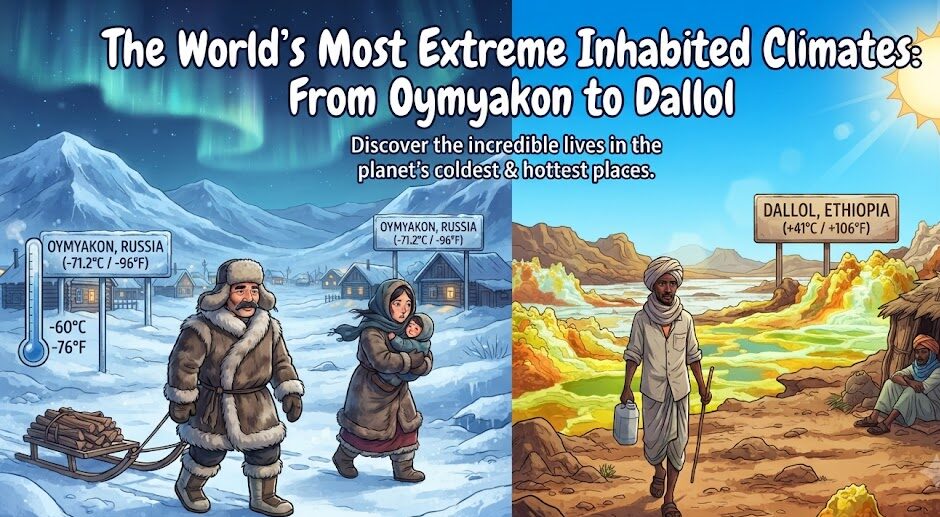
Human beings are remarkably adaptable biological organisms. While our species evolved in the balmy equatorial savannas of East Africa, human civilization has systematically colonized nearly every ecological niche on the planet. From Siberian valleys where liquid mercury freezes solid in mid-winter to hydrothermal depressions where toxic volcanic gases and blistering heat persist year-round, human settlements thrive in the most extreme climatic environments on Earth. Investigating these settlements illustrates the remarkable intersection of geomorphology, atmospheric physics, indigenous resilience, and modern civil engineering.
The Mechanics of Climate Extremes: Continental vs. Maritime
Planetary climate extremes are governed by fundamental physical laws of thermodynamics and geographic positioning:
Continentality: Land has a significantly lower specific heat capacity than water. Land heats up rapidly in summer and cools down catastrophically in winter. Consequently, deep continental interiors insulated thousands of kilometers away from moderating oceanic air masses experience the world’s most extreme annual temperature ranges (exceeding 100°C / 180°F between winter lows and summer highs).
Thermal Inversion in Mountain Basins: In deep valleys surrounded by high mountain chains, dense, cold polar air drains down mountain slopes at night and pools at the bottom of the basin, trapped beneath a ceiling of warmer air, creating extreme sub-zero cold traps.
Subtropical High-Pressure Subsidence: Along the Hadley Cell descent at roughly 30 degrees north and south latitude, sinking dry air masses suppress cloud formation and precipitation, exposing barren terrain to uninterrupted solar radiation.
| Settlement / Region | Country | Extreme Climatic Category | Recorded Benchmark Metric | Human Adaptation & Economic Activity |
|---|---|---|---|---|
| Oymyakon & Verkhoyansk | Russia (Sakha Republic) | Coldest Permanently Inhabited | -67.7°C (-89.9°F) / -71.2°C | Reindeer herding, horse breeding, fur trapping; houses elevated on stilts over permafrost. |
| Dallol & Danakil Depression | Ethiopia (Afar Region) | Hottest Year-Round Inhabited | Average annual temp: 34.6°C (94.3°F) | Traditional Afar salt mining and camel caravans across hyper-arid salt flats. |
| Mawsynram & Cherrapunji | India (Meghalaya) | Wettest Inhabited Place on Earth | 11,872 mm (467.4 in) annual rain | Living root bridges (Ficus elastica) trained across swollen mountain torrents. |
| Arica & San Pedro de Atacama | Chile (Atacama Desert) | Driest Inhabited Non-Polar Region | 0.76 mm average annual precipitation | Fog harvesting nets (camanchaca), lithium brine mining, international astronomy observatories. |
| La Rinconada | Peru (Puno Region) | Highest Elevation Human Settlement | 5,100 m (16,730 ft) above sea level | Unregulated artisanal gold mining beneath Mount Ananea glacier; chronic hypoxia. |
Deep Freeze: Oymyakon and the Siberian Pole of Cold
Nestled in a remote river valley in eastern Siberia within the Sakha Republic (Yakutia), Russia, the village of Oymyakon holds the official distinction of being the coldest permanently inhabited settlement on Earth. Situated between two mountain ranges that trap freezing air masses, Oymyakon recorded a certified minimum temperature of -67.7°C (-89.9°F) on February 6, 1933, with an unverified local measurement of -71.2°C recorded in 1924.
Life in Oymyakon requires extraordinary human adaptation. Because the ground is underlain by continuous permafrost hundreds of meters deep, modern indoor plumbing is virtually impossible, as water in subterranean pipes would freeze and rupture within hours. Vehicles must be parked in heated garages or kept idling continuously outdoors to prevent motor oil, fuel lines, and hydraulic fluids from solidifying. The local diet is almost entirely carnivorous—relying on frozen horse meat, reindeer meat, and raw arctic fish (stroganina)—as crops cannot grow in subarctic permafrost.
The Hydrothermal Furnace: Dallol in the Danakil Depression
At the opposite thermodynamic extreme lies the abandoned ghost settlement of Dallol in the Danakil Depression of northern Ethiopia. Sitting approximately 130 meters (430 feet) below sea level in the Afar Triangle—where three tectonic plates are actively rifting apart—Dallol holds the record for the highest average year-round temperature ever recorded for an inhabited site: between 1960 and 1966, the daily maximum temperature averaged 41.1°C (106.0°F), with a relentless daily mean temperature of 34.6°C (94.3°F).
Dallol resembles an alien planet: hyper-saline hydrothermal brine pools bubble with toxic sulfuric acid, chlorine gases, and bright green and neon yellow sulfur deposits. Despite these lethal conditions, indigenous Afar miners have harvested salt slabs by hand for centuries, carving blocks of “white gold” and loading them onto camel caravans for transport across the mountains to Ethiopian highland markets.
Frequently Asked Questions About Extreme Climates
What is the highest temperature ever reliably recorded on Earth?
The highest reliably certified ambient air temperature on Earth is 54.4°C (130.0°F), recorded at Furnace Creek in Death Valley, California, on August 16, 2020, and verified again on July 9, 2021, by the World Meteorological Organization (WMO). While a historic 56.7°C (134°F) was reported in Death Valley in 1913, modern meteorologists consider that measurement scientifically flawed.
How do humans survive living at 5,100 meters in La Rinconada, Peru?
At 5,100 meters above sea level, atmospheric pressure is roughly 50% lower than at sea level. The native Quechua population living in the gold-mining town of La Rinconada exhibits genetic adaptations developed over millennia, including higher red blood cell counts (elevated hematocrit levels), larger lung capacities, and enhanced cardiovascular efficiency, though many suffer from chronic mountain sickness.
Why doesn’t it rain in the Atacama Desert?
The Atacama Desert in northern Chile is the driest non-polar desert on Earth due to a “two-sided rain shadow”: the soaring Andes mountains block all moisture-bearing air from the Amazon basin to the east, while the cold offshore Humboldt Current in the Pacific creates a persistent marine inversion layer that chills coastal air, preventing convective precipitation from forming in the west.