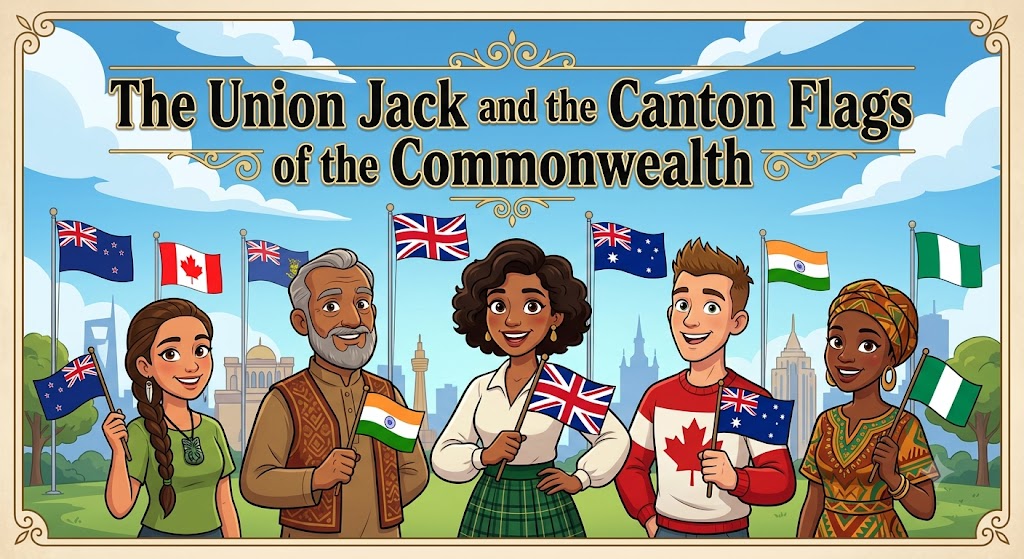
The Union Flag—popularly and colloquially known worldwide as the Union Jack—is arguably the most historically influential, geometrically intricate, and globally replicated national banner in modern history. Serving as the sovereign flag of the United Kingdom of Great Britain and Northern Ireland, it represents the physical heraldic amalgamation of three distinct patron saint crosses. Beyond the British Isles, the Union Flag occupies the upper hoist quadrant (the canton) on dozens of national, state, and provincial flags across the globe, leaving an indelible cartographic imprint of the British Empire and the modern Commonwealth of Nations.
The Heraldic Fusion: Three Saints in One Banner
Unlike flags engineered from abstract revolutionary concepts, the Union Jack is a literal heraldic layering of sovereign crowns and historical kingdoms. Its development unfolded in two major constitutional stages over two centuries.
1. The Union of the Crowns (1606)
Following the death of Queen Elizabeth I in 1603, King James VI of Scotland inherited the English throne, becoming King James I of England. In 1606, King James commissioned a combined maritime standard to unify his two separate kingdoms under a shared flag. The design superimposed the red vertical and horizontal cross of Saint George (patron saint of England, featuring a red cross on a white field) directly atop the white diagonal saltire of Saint Andrew (patron saint of Scotland, featuring a white diagonal cross on an azure blue field).
To preserve heraldic rules of tincture, a thin white border (fimbriation) was placed around the red English cross to prevent red from directly touching the blue Scottish background. This design remained the sovereign standard through the formal 1707 Acts of Union, which created the Kingdom of Great Britain.
2. The Act of Union with Ireland (1801)
In 1801, the Kingdom of Great Britain united with the Kingdom of Ireland to establish the United Kingdom of Great Britain and Ireland. To incorporate Ireland into the national flag, heralds integrated the red diagonal saltire of Saint Patrick (patron saint of Ireland). However, simply layering St Patrick’s red saltire over St Andrew’s white saltire would have completely obscured the Scottish cross.
The heraldic solution was brilliant: the two diagonal saltires were “counterchanged”—arranged side by side in alternating half-segments. St Andrew’s white saltire is broader and takes precedence in the upper hoist quadrant, while St Patrick’s red saltire sits off-centered. This subtle asymmetry means the Union Jack has a correct right-side-up orientation; flying the flag upside down (with the thin white stripe at the top hoist) is a traditional international maritime signal of acute distress.
| Country / Territory | Ensign Base | Canton | Fly Field Elements | Year Adopted |
|---|---|---|---|---|
| Australia | British Blue Ensign | Union Jack | Commonwealth Star (7 points) + Southern Cross constellation | 1901 / 1954 (official) |
| New Zealand | British Blue Ensign | Union Jack | Southern Cross constellation (4 red stars edged in white) | 1902 |
| Fiji | Light Blue Ensign | Union Jack | National Coat of Arms (British lion holding cacao, sugar cane, coconut, dove) | 1970 |
| Tuvalu | Light Blue Ensign | Union Jack | Nine yellow stars representing the nine Pacific atolls | 1978 / 1997 |
| Cook Islands | British Blue Ensign | Union Jack | Ring of 15 white five-pointed stars representing the islands | 1979 |
| Hawaii (US State) | Custom Striped | Union Jack | Eight horizontal stripes (white, red, blue) representing the 8 main islands | 1845 / 1959 |
The Admiralty System: White, Blue, and Red Ensigns
To understand why the Union Jack appears in the canton of so many world flags, one must examine the seventeenth-century British Admiralty naval classification system. British maritime vessels were strictly partitioned into three fleets, each flying a distinct colored ensign:
The White Ensign: Featuring the St George’s cross with the Union Jack in the canton, flown exclusively by the Royal Navy and the Royal Yacht Squadron.
The Blue Ensign: A solid dark blue field with the Union Jack in the canton, originally flown by the naval reserve and government-owned civilian vessels (customs, port authorities, scientific surveys).
The Red Ensign (“The Red Duster”): A solid red field with the Union Jack in the canton, flown by merchant vessels and commercial private shipping.
Under the Colonial Naval Defence Act of 1865, British overseas colonies were granted permission to operate their own local vessels under a Blue Ensign defaced with a distinctive local badge or emblem placed in the fly (the right half of the flag). When colonies such as Australia, New Zealand, Fiji, and Canada progressed to dominion status and independent nationhood, they retained their defaced Blue Ensigns as sovereign national banners.
Debates Over Modern Flag Modification: The Case of New Zealand and Australia
In the post-colonial era, the continued presence of the British Union Jack on sovereign flags has sparked passionate national identity debates across the southern hemisphere.
New Zealand’s 2015–2016 Flag Referendums
In 2015, the government of New Zealand launched an official two-stage national referendum to consider replacing its colonial-era Blue Ensign flag. Proponents of change argued that the existing flag was frequently confused with Australia’s flag and failed to represent New Zealand’s modern multicultural identity and indigenous Māori heritage. A shortlist was selected featuring the iconic Silver Fern emblem. However, in the final binding referendum in March 2016, 56.6% of New Zealand voters chose to retain the traditional flag with the Union Jack, with many citizens citing respect for historical military service under the existing banner in two World Wars.
The Canadian Precedent: The 1965 Great Flag Debate
Nations that chose to replace their colonial canton flags provide a precedent for how national symbolism matures. Until 1965, Canada flew the Canadian Red Ensign—a red maritime flag with the Union Jack in the canton and the Canadian shield in the fly. As separatist sentiment grew in francophone Quebec, where the British flag was viewed as a symbol of historical conquest, Prime Minister Lester B. Pearson initiated the Great Flag Debate. On February 15, 1965, Canada officially adopted the stylized eleven-point red Maple Leaf flag, successfully uniting anglophone and francophone Canadians under a neutral, distinctive emblem.
Frequently Asked Questions About the Union Jack
Why is Wales not represented on the Union Jack?
When the first Union Flag was created in 1606, the Principality of Wales had already been legally annexed and incorporated into the Kingdom of England under the Laws in Wales Acts of 1535 and 1542. Consequently, Wales was considered an integral part of England rather than a separate sovereign kingdom, and its iconic Red Dragon (Y Ddraig Goch) was not granted separate heraldic inclusion.
What is the proper protocol for flying the Union Jack right-side-up?
To fly the Union Jack correctly, the broader white diagonal band of St Andrew must be situated above the thinner red diagonal band of St Patrick in the upper-left corner nearest the flagpole (the upper hoist quadrant). Flying the flag upside down is an international breach of vexillological protocol, traditionally used only to signal life-threatening maritime distress.
How many sovereign nations currently feature the Union Jack on their national flag?
Today, five sovereign nations retain the Union Jack on their official national flags: the United Kingdom, Australia, New Zealand, Fiji, and Tuvalu. Additionally, the Cook Islands and Niue (self-governing states in free association with New Zealand) and dozens of British Overseas Territories (such as Bermuda, Cayman Islands, and Falkland Islands) feature the Union Jack.