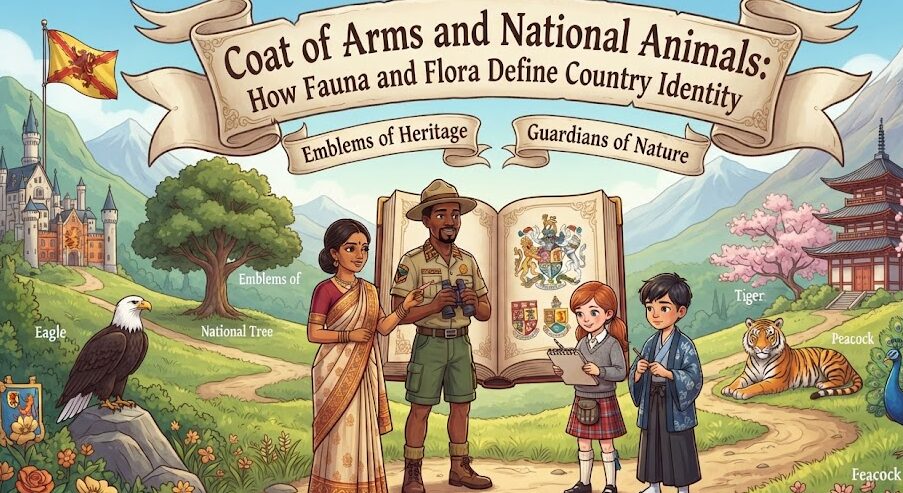
Beyond the geometric abstraction of national flags, sovereign nations project their sovereign power, ecological inheritance, and spiritual aspirations through intricate heraldic seals, coats of arms, and official national flora and fauna. Throughout human civilization, societies have selected apex predators, resilient trees, mythical beasts, and endemic botanical treasures to serve as biological ambassadors of the state. From the soaring eagles of continental empires to the marsupials of Australasia, exploring national heraldry reveals how human societies construct political mythologies out of the living natural world.
The Apex Predators of Heraldry: Lions and Eagles
In classical European and Eurasian heraldry, two animal species command near-absolute dominance: the lion, symbolizing terrestrial courage and sovereignty over the earth, and the eagle, representing celestial vision, dominance of the sky, and imperial transcendence.
The King of Beasts: The Lion Rampant and Passant
The lion (Panthera leo) appears on the official coats of arms of dozens of nations where the species has never naturally existed in modern times, including the United Kingdom, the Netherlands, Belgium, Sweden, Norway, Denmark, and the Czech Republic. Imported via classical biblical texts and Greco-Roman traditions, the lion represented royal authority, chivalric ferocity, and divine right of kingship.
In medieval heraldic posture, lions are strictly categorized: a lion rampant stands upright on its hind legs with forepaws raised in battle posture (as on the Royal Banner of Scotland), while a lion passant walks forward with one paw raised, gazing straight ahead (as on the Three Lions of the Royal Arms of England, originally leopards in Anglo-Norman heraldry).
The Double-Headed Imperial Eagle
The eagle has functioned as the supreme insignia of empire since the Roman Republic adopted the Aquila as the sacred legionary standard. Under the Byzantine Empire, heralds developed the double-headed eagle—a single eagle body supporting two heads facing simultaneously east and west, symbolizing the emperor’s supreme dominion over both Europe and Asia, and over both church and state.
Following the fall of Constantinople in 1453, the double-headed eagle was adopted by the Russian Empire as the “Third Rome,” and it remains the official state emblem of the Russian Federation today. Similarly, the Holy Roman Empire, the Austro-Hungarian Empire, and the modern Republic of Albania retained the double-headed raptor as their enduring national insignia.
| Country | Official National Animal | Official National Floral / Tree Symbol | Heraldic / Cultural Meaning |
|---|---|---|---|
| United States | Bald Eagle (Haliaeetus leucocephalus) | Rose (Floral) / Oak (National Tree) | Native North American apex raptor; freedom and territorial strength. |
| India | Bengal Tiger (Panthera tigris tigris) | Lotus (Nelumbo nucifera) / Banyan Tree | Agility, grace, and immense power; lotus represents spiritual purity amidst adversity. |
| Australia | Red Kangaroo & Emu | Golden Wattle (Acacia pycnantha) | Neither animal can easily walk backwards, symbolizing a nation moving always forward. |
| Canada | North American Beaver (Castor canadensis) | Sugar Maple Leaf (Acer saccharum) | Pioneering industry, resourcefulness, and the fur trade that founded early commerce. |
| Scotland | Unicorn (Mythical) | Thistle (Onopordum acanthium) | Untamable independence; Celtic mythology counterpart to the English lion. |
| South Africa | Springbok (Antidorcas marsupialis) | King Protea (Protea cynaroides) | Agility and speed across the veld; protea represents botanical resilience. |
Botanical Sovereignty: Trees, Flowers, and Agriculture
While fauna embodies physical strength and agility, national flora typically symbolizes enduring roots, historical longevity, agricultural fertility, and territorial attachment.
The Cedar of Lebanon
The Cedar of Lebanon (Cedrus libani) holds the rare distinction of being centered directly on a sovereign national flag. Renowned since antiquity and referenced over 70 times in the Hebrew Bible, the towering, evergreen cedars were harvested by King Solomon to build the Temple in Jerusalem and by Phoenician shipwrights to construct the Mediterranean’s premier trading fleet. On the flag of Lebanon, the green cedar stands between two red bands (representing blood shed for independence), symbolizing eternal life, resilience against foreign conquerors, and peace.
The Canadian Maple Leaf
Long before European contact, indigenous First Nations peoples harvested the sweet sap of the sugar maple (Acer saccharum) every spring as a vital nutritional lifeline. By the early nineteenth century, French Canadian settlers adopted the maple leaf as a regional emblem, which was later incorporated into British colonial military badges. In 1965, the stylized 11-point maple leaf became Canada’s definitive national symbol, transcending linguistic divisions between English and French speakers.
Mythical Beasts in National Heraldry
Not all national animals belong to real-world biological taxonomy. Several sovereign states have deliberately selected mythical creatures to embody spiritual ideals, ancient folklore, and untamable sovereignty.
Scotland (The Unicorn): The official national animal of Scotland is the mythical unicorn. In medieval Celtic folklore, the unicorn was regarded as a noble beast possessing supreme purity, beauty, and untamable ferocity, capable of slaying lions. In Scottish heraldry, the royal unicorn is always depicted bound by a golden chain; according to folklore, a free unicorn was so dangerously fierce that only a virgin or a righteous king could tame it, symbolizing that Scottish kings possessed the virtue to govern an untamable people.
Bhutan (The Druk Thunder Dragon): The official name of Bhutan in the Dzongkha language is Druk Yul—”The Land of the Thunder Dragon.” Centered on the national flag of Bhutan is the Druk, a pure white dragon clutching sacred wish-fulfilling jewels (norbu) in its claws, symbolizing the country’s spiritual wealth, purity of deeds, and sovereign protection.
Frequently Asked Questions About Coats of Arms
Why does the United States coat of arms feature 13 arrows and 13 olives?
The Great Seal of the United States features a Bald Eagle holding an olive branch with 13 olives in its right talon (symbolizing peace) and a bundle of 13 arrows in its left talon (symbolizing readiness for war). The number 13 represents the original thirteen American colonies that declared independence from Britain in 1776.
What is the national animal of India?
The Royal Bengal Tiger (Panthera tigris tigris) is the official national animal of India, designated in 1973 to replace the Asiatic lion, highlighting the government’s pioneering conservation initiative, Project Tiger, and reflecting the animal’s subcontinental majesty, strength, and grace.
What is a “supporter” in heraldic design?
In heraldry, supporters are two figures (usually animals, mythical beasts, or human allegorical figures) positioned on either side of the central heraldic shield, depicted as physically holding or supporting the shield upright atop a ground compartment, such as the Lion and Unicorn supporting the Royal Arms of the United Kingdom.