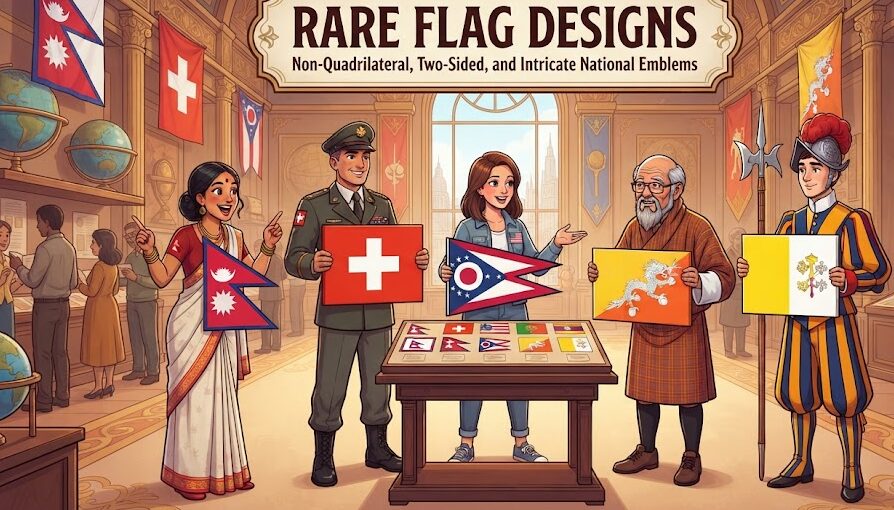
Of the 195 sovereign member states recognized by the United Nations, 190 adhere strictly to a standard rectangular geometry. Rectangles offer optimal industrial efficiency: they are easy to mass-produce, fold, store, and fly cleanly from standard vertical flagpoles. However, the world of sovereign vexillology contains extraordinary geometric outliers, ancient theological exceptions, and complex optical designs that defy modern global uniformity. From the only sovereign flag with non-quadrilateral geometry to double-sided flags featuring completely different emblems on front and back, rare national flags offer profound windows into unique cultural, religious, and political worldviews.
The Geometric Outliers: Escaping the Rectangle
Standard rectangular flags are characterized by an aspect ratio—the proportion of height to width. Common aspect ratios include 2:3 (used by France, Italy, and India) and 1:2 (used by the United Kingdom, Canada, and Australia). Yet three sovereign states completely reject rectangular proportions.
| Country | Shape / Aspect Ratio | Unique Optical Feature | Cultural / Theological Meaning |
|---|---|---|---|
| Nepal | Double Pennant (Non-Quadrilateral) | Only non-quadrilateral national flag in the world; mathematically codified in constitution. | Himalayan peaks; Hindu and Buddhist religious pennants; sun and crescent moon. |
| Switzerland | Square (1:1 Aspect Ratio) | Equilateral white cross on red square field. | Medieval canton of Schwyz; emblem of absolute neutrality and humanitarian defense. |
| Vatican City | Square (1:1 Aspect Ratio) | Yellow and white vertical bands with Papal Tiara and Crossed Keys of St. Peter. | Keys of the Kingdom of Heaven (gold for spiritual, silver for temporal authority). |
| Paraguay | Two-Sided (Obverse vs. Reverse) | Front features National Coat of Arms; Back features Treasury Seal. | Peace and Justice; Phrygian cap of liberty guarded by a seated lion on reverse. |
| Dominica | Features Purple Tincture | Imperial Amazon parrot (Sisserou) depicted in natural purple plumage. | Endemic national bird; biodiversity and resilience of the Caribbean island. |
Nepal: The World’s Only Non-Quadrilateral National Flag
The national flag of Nepal is globally unique: it is the only sovereign national banner that is neither a rectangle nor a square. Instead, it consists of a stacked double pennant (two triangular pennants joined vertically along the hoist). Framed in deep blue to symbolize peace and friendship, the interior field is crimson red—the color of Nepal’s national flower, the rhododendron, and a historical symbol of bravery.
The Mathematical Wonder of the Nepalese Constitution
The triangular shapes represent the soaring jagged ridgelines of the Himalayas. The upper pennant contains a stylized white crescent moon emitting eight rays, while the lower pennant contains a white sun with twelve rays. Historically, these celestial symbols represented the Rana and Shah dynasties, while expressing the cosmic hope that the nation of Nepal will endure as long as the sun and moon illuminate the sky.
When Nepal adopted its modern democratic constitution in 1962 (and reaffirmed in the 2015 Constitution), Schedule 1 of the document codified an extraordinary step-by-step mathematical algorithm for constructing the flag using only an unmarked straightedge and compass. The instructions specify precise geometric intersections, bisecting angles, and arc radii, ensuring that any geometer anywhere on Earth can draft the exact sacred proportions without relying on arbitrary digital templates.
The Two-Sided Marvel: The Republic of Paraguay
While almost all sovereign flags are designed symmetrically so that the reverse side is a mirror reflection of the obverse, the South American nation of Paraguay flies a flag that is officially non-reversible: the front side and the back side display two entirely different national emblems.
Adopted in 1842 under the administration of consuls Mariano Roque Alonso and Carlos Antonio López, the flag consists of three equal horizontal stripes of red, white, and blue (inspired by the French revolutionary colors representing justice, peace, and liberty). However, the central white stripe features different emblems:
The Obverse (Front Side): Displays the official National Coat of Arms of Paraguay—a yellow five-pointed “Star of May” (commemorating the May 1811 independence) encircled by green palm and olive branches, tied with a ribbon and enclosed by the words REPÚBLICA DEL PARAGUAY.
The Reverse (Back Side): Displays the official Seal of the National Treasury—a golden lion sitting erect beside a staff topped with a Phrygian cap (the ancient liberty cap), surmounted by the national motto PAZ Y JUSTICIA (“Peace and Justice”). The reverse serves as an explicit constitutional pledge that national freedom will be fiercely defended by the power of the state.
The Perfect Squares: Switzerland and Vatican City
Only two sovereign states in the world fly perfectly square flags with an exact 1:1 aspect ratio: the Swiss Confederation and the State of the Vatican City.
Switzerland’s Maritime Exception
The Swiss square flag originates from the medieval military banner of the canton of Schwyz—one of the three founding cantons of the Old Swiss Confederacy in 1291. Swiss mercenaries carried the white couped cross into battle to distinguish themselves from rival Holy Roman Empire forces. In 1848, the square red flag with the centered white cross became the official federal standard.
Interestingly, Switzerland maintains a fascinating geographic exception: while the terrestrial flag is strictly square, Swiss commercial merchant ships navigating international waterways (such as the Rhine River or high-seas shipping registries) fly a rectangular 2:3 version under federal maritime law, because international maritime authorities generally require rectangular ensigns for aerodynamic stability on ship masts.
Vatican City: The Holy See Standard
Established under the 1929 Lateran Treaty between the Holy See and the Kingdom of Italy, Vatican City is the smallest sovereign nation on Earth (0.49 km²). Its official square standard features two equal vertical fields of yellow and white—violating heraldic tincture rules by placing metal against metal. The white fly half bears the Papal Tiara and the crossed Keys of Saint Peter (one gold, one silver) bound with a red cord, symbolizing the papal authority to bind and loose in the Kingdom of Heaven.
Frequently Asked Questions About Unique Flag Designs
Which country had a completely solid-color flag?
From 1977 until 2011, the North African nation of Libya under Muammar Gaddafi flew a completely solid green flag with no emblems, lettering, insignia, or secondary colors. It was the only monochromatic sovereign flag in the world, chosen to symbolize both the Islamic faith and Gaddafi’s political philosophy outlined in his “Green Book.”
What is the most complex national flag to draw?
The flag of Belize is widely recognized as one of the most complex in the world. It features a prominent coat of arms depicting two woodcutters (one mestizo, one of African descent) holding logging tools beneath a mahogany tree, surrounded by a complex wreath of 50 mahogany leaves, incorporating nineteen distinct colors.
Which national flag has a building depicted on it?
The national flag of Cambodia features a white depiction of the ancient twelfth-century temple complex of Angkor Wat centered on a red field between two blue horizontal stripes, symbolizing the Khmer people’s deep spiritual and architectural heritage.