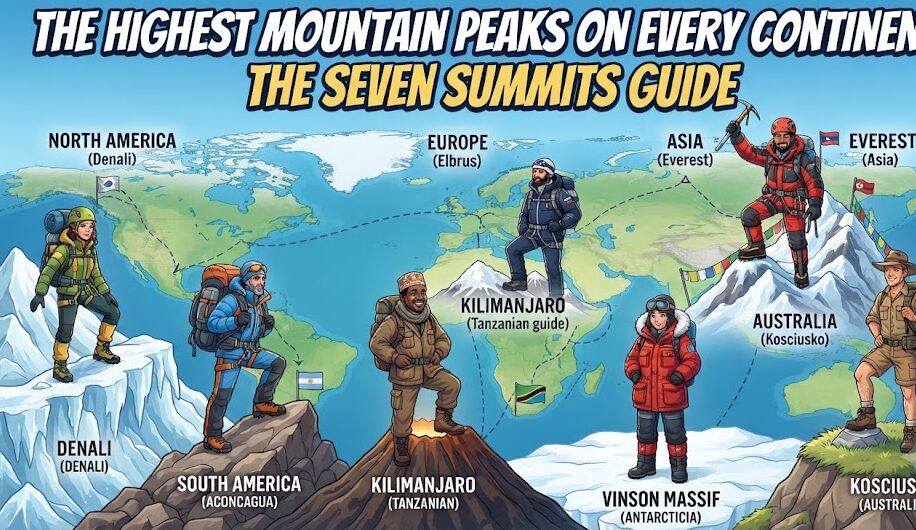
For mountaineers, geologists, and adventurers, the “Seven Summits”—the highest mountain peaks on each of Earth’s seven continents—represent the ultimate global mountaineering milestone and a grand tour of planetary orogeny. Conceived as a formal mountaineering challenge in the 1980s by American businessman Richard Bass, climbing the Seven Summits requires mastering extreme high-altitude physiology in the Himalayas, sub-zero glacial storms in Antarctica, active volcanic crags in the Caucasus, and equatorial rainforest ascents in New Guinea.
The Two Competing Lists: Bass vs. Messner
In mountaineering circles, there are two recognized definitions of the Seven Summits, stemming from geographical debates over continental boundaries in Oceania and Europe:
The Bass List: Compiled by Dick Bass, who completed the circuit in 1985. Bass defined Australia as the continent, designating Mount Kosciuszko (2,228 m) as its highest point.
The Messner List: Proposed by legendary Italian alpinist Reinhold Messner, the first person to climb all 14 eight-thousanders without supplemental oxygen. Messner argued that Australia is part of the wider geographic continent of Oceania, designating the far more formidable and technically demanding peak of Puncak Jaya (Carstensz Pyramid) (4,884 m) on the island of New Guinea as the true continental summit. Most serious mountaineers prefer the Messner list.
| Peak Name | Continent | Mountain Range | Elevation | First Recorded Ascent | Primary Climbing Challenges |
|---|---|---|---|---|---|
| Mount Everest (Sagarmatha) | Asia | Mahalangur Himalayas (Nepal/China) | 8,848.86 m / 29,031.7 ft | 1953 (Hillary & Norgay) | Extreme hypoxia (Death Zone >8,000 m), jet stream winds, Khumbu Icefall. |
| Aconcagua | South America | Principal Cordillera (Andes, Argentina) | 6,961 m / 22,838 ft | 1897 (Matthias Zurbriggen) | Severe altitude sickness, fierce gale winds (“Viento Blanco”), extreme dry cold. |
| Denali (Mount McKinley) | North America | Alaska Range (United States) | 6,190 m / 20,310 ft | 1913 (Hudson Stuck expedition) | Extreme subarctic cold, massive vertical relief (5,500 m), glacier crevasses. |
| Kilimanjaro (Uhuru Peak) | Africa | Eastern Rift Mountains (Tanzania) | 5,895 m / 19,341 ft | 1889 (Meyer & Purtscheller) | Rapid altitude gain across 5 ecological zones, acute mountain sickness (AMS). |
| Mount Elbrus | Europe | Caucasus Mountains (Russia) | 5,642 m / 18,510 ft | 1874 (Florence Crauford Grove) | Severe sudden blizzards, sub-zero temperatures, crevasse fields. |
| Vinson Massif | Antarctica | Sentinel Range (Ellsworth Mtns) | 4,892 m / 16,050 ft | 1966 (American Antarctic expedition) | Extreme polar isolation, katabatic winds, -40°C base temperatures. |
| Puncak Jaya (Carstensz Pyramid) | Oceania (Messner) | Sudirman Range (Papua, Indonesia) | 4,884 m / 16,024 ft | 1962 (Heinrich Harrer expedition) | Technical rock climbing (limestone wall), dense equatorial jungle trek. |
| Mount Kosciuszko | Australia (Bass) | Snowy Mountains (NSW, Australia) | 2,228 m / 7,310 ft | 1840 (Paweł Strzelecki) | Non-technical hike; walking trail accessible to general public. |
Detailed Profiles of the Seven Summits
1. Mount Everest (Asia, 8,848.86 m)
Straddling the international boundary between Nepal and China (Tibet), Mount Everest is the highest point on Earth above sea level. Formed by the ongoing collision between the Indian and Eurasian tectonic plates, Everest is composed of marine limestone and shale that were once sediments at the bottom of the ancient Tethys Sea.
Above 8,000 meters lies the “Death Zone,” where atmospheric pressure drops to roughly one-third of sea level value, meaning human cells consume oxygen faster than respiration can replenish it. Climbers face severe risks of High Altitude Pulmonary Edema (HAPE) and Cerebral Edema (HACE), making supplemental bottled oxygen and expert Sherpa guidance vital for survival.
2. Aconcagua (South America, 6,961 m)
Located in the Mendoza Province of Argentina near the border with Chile, Aconcagua is the highest mountain in both the Southern and Western Hemispheres, and the highest peak in the world outside the mountain systems of Central Asia. Originating as a volcanic complex that was later structurally uplifted, it is often nicknamed the “Stone Sentinel.” While the standard route does not require technical ropes or ice axes, its extreme altitude and sudden, ferocious gale-force storms (the dreaded Viento Blanco) claim numerous lives annually.
3. Denali (North America, 6,190 m)
Rising majestically out of the Alaska Range, Denali (formerly known as Mount McKinley) features the greatest vertical relief of any mountain on Earth situated entirely on dry land: its base sits at approximately 600 meters elevation, giving it an unbroken vertical rise of 5,500 meters (18,000 feet)—considerably greater than the base-to-peak rise of Mount Everest.
Situated at 63 degrees north latitude, Denali is subjected to brutal subarctic weather systems. Furthermore, because atmospheric pressure decreases toward the poles due to the Earth’s centrifugal rotation and cold air density, the effective physiological altitude on Denali feels roughly 1,000 meters higher than equivalent elevations in the Himalayas.
Frequently Asked Questions About the Seven Summits
Is Mount Blanc or Mount Elbrus the highest mountain in Europe?
Under modern geographic conventions defining the border between Europe and Asia along the Greater Caucasus watershed, Mount Elbrus (5,642 m) in southwestern Russia is officially recognized as the highest peak in Europe. Mont Blanc (4,808 m) in the Alps is the highest peak in Western Europe, but it is 834 meters lower than Elbrus.
What is the easiest of the Seven Summits to climb?
Under the Bass list, Mount Kosciuszko in Australia is by far the easiest: it is a non-technical 4-to-5-hour walk on a paved trail and metal walkway from the Thredbo ski resort, accessible to children and elderly hikers during summer. Under the Messner list, Kilimanjaro is considered the most accessible non-technical high summit, though it still poses acute altitude risks.
Who was the first person to climb all Seven Summits?
American entrepreneur and mountaineer Richard “Dick” Bass completed the circuit on April 30, 1985, reaching the summit of Mount Everest after having ascended Aconcagua, Denali, Kilimanjaro, Elbrus, Vinson, and Kosciuszko, publishing his bestselling memoir Seven Summits.