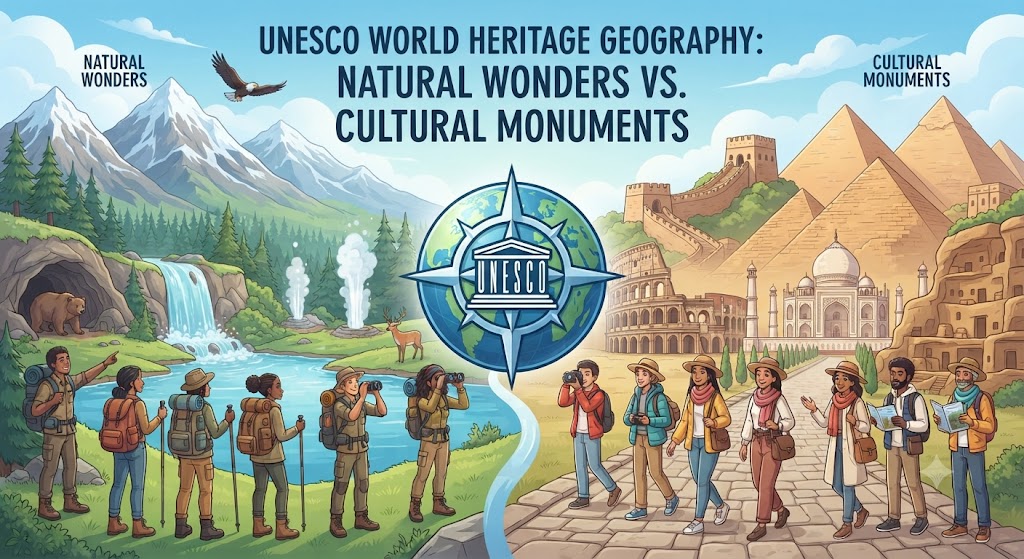
In 1972, the General Conference of the United Nations Educational, Scientific and Cultural Organization (UNESCO) adopted a revolutionary international legal treaty: the Convention Concerning the Protection of the World Cultural and Natural Heritage. Grounded in the visionary philosophy that certain geographical landscapes, natural ecosystems, and human architectural monuments possess “Outstanding Universal Value” (OUV) belonging to all humanity, the World Heritage List has expanded to encompass over 1,200 inscribed properties across more than 160 state parties. Analyzing the spatial geography of these sites provides deep insights into planetary conservation, archaeological preservation, and international environmental law.
The Dual Pillars: Natural vs. Cultural Heritage
UNESCO classifies World Heritage properties into three distinct categories:
Cultural Heritage: Historical architectural monuments, groups of buildings, archaeological ruins, technological complexes, and cultural landscapes created by human ingenuity. Candidates must satisfy one or more of six cultural criteria (e.g., representing a masterpiece of human creative genius, exhibiting an important interchange of human values, or bearing unique testimony to a disappeared civilization).
Natural Heritage: Physical and biological formations, geological or physiographical features, habitats of threatened animal and plant species, and areas of exceptional natural beauty. Candidates must satisfy one or more of four natural criteria (e.g., major stages of Earth’s history, ongoing ecological processes, superlative natural phenomena, or significant natural habitats for in-situ conservation of biological diversity).
Mixed Heritage: Properties that satisfy both cultural and natural criteria simultaneously, demonstrating profound symbiotic interactions between indigenous human cultures and extraordinary natural environments (e.g., Machu Picchu in Peru, Meteora in Greece, or the Tasmanian Wilderness in Australia).
| Country | Total Inscribed Sites | Cultural Sites | Natural Sites | Mixed Sites | Iconic Benchmark Properties |
|---|---|---|---|---|---|
| Italy | 60 | 54 | 6 | 0 | Historic Center of Rome, Pompeii, Venice & Lagoon, Dolomites. |
| China | 59 | 40 | 15 | 4 | Great Wall, Terracotta Army, Jiuzhaigou Valley, Mount Taishan (mixed). |
| Germany | 54 | 51 | 3 | 0 | Cologne Cathedral, Museum Island Berlin, Wadden Sea (natural). |
| France | 53 | 44 | 7 | 2 | Mont-Saint-Michel, Palace of Versailles, French Austral Lands (natural). |
| Spain | 50 | 44 | 4 | 2 | Alhambra Granada, Sagrada Família, Doñana National Park (natural). |
| India | 42 | 34 | 7 | 1 | Taj Mahal, Ajanta Caves, Sundarbans (natural), Khangchendzonga (mixed). |
| United States | 26 | 13 | 12 | 1 | Yellowstone, Grand Canyon, Statue of Liberty, Cahokia Mounds. |
Geographic Imbalances and the Eurocentric Critique
Despite its universalist ideals, the World Heritage List exhibits pronounced geographic imbalances. Nearly half of all inscribed sites are concentrated in Europe and North America, with Mediterranean nations like Italy, Spain, France, and Germany dominating the cultural rankings. This concentration stems from historical funding disparities: wealthy developed nations possess substantial archaeological budgets, specialized conservation institutes, and administrative bandwidth to prepare the exhaustive, multi-volume technical dossiers required by the World Heritage Committee.
In response, UNESCO launched the “Global Strategy for a Balanced, Representative and Credible World Heritage List” in 1994, explicitly encouraging nominations of non-European cultural landscapes, living vernacular traditions, industrial heritage, and underrepresented African and Oceanian ecological habitats.
Natural Heritage Under Siege: Climate Change and Extinction
While ancient stone monuments face threats from urban air pollution, tourism pressure, and armed conflict, natural World Heritage sites are on the front lines of global climate change. The Great Barrier Reef in Australia—the world’s largest coral reef ecosystem spanning over 2,300 kilometers—has experienced multiple mass coral bleaching events driven by marine heatwaves, sparking intense diplomatic debates over whether UNESCO should classify the reef on the official “List of World Heritage in Danger.”
Similarly, tropical rainforest sites in the Amazon, Congo Basin, and Sumatra face intense fragmentation from illegal logging, road construction, agricultural encroachment, and poaching, highlighting the limitations of international treaty designations when sovereign enforcement mechanisms on the ground are under-resourced.
Frequently Asked Questions About World Heritage
Has a site ever been delisted (stripped of World Heritage status)?
Yes. UNESCO has permanently revoked World Heritage status from three properties in history: the Arabian Oryx Sanctuary in Oman (in 2007, after Oman reduced the reserve size by 90% for hydrocarbon exploration), the Dresden Elbe Valley in Germany (in 2009, following the construction of a four-lane highway bridge that bisected the historic cultural landscape), and Liverpool Maritime Mercantile City in the UK (in 2021, due to irreversible urban waterfront redevelopment).
What is a transboundary World Heritage site?
A transboundary site is a unified property that crosses international borders, managed collaboratively by multiple sovereign states. Famous examples include Victoria Falls (shared between Zambia and Zimbabwe), the Wadden Sea (shared by Denmark, Germany, and the Netherlands), and the Primeval Beech Forests of the Carpathians and Other Regions of Europe (spanning 18 European nations).
What is the difference between tangible and intangible heritage?
Tangible World Heritage consists of physical, immovable physical monuments, buildings, and natural ecosystems governed by the 1972 Convention. Intangible Cultural Heritage, governed by a separate 2003 UNESCO Convention, protects living traditions, oral folklore, performing arts, social rituals, and traditional craftsmanship (such as the Mediterranean diet, flamenco dance, or Reggae music of Jamaica).